

Looking for the best beginner camera for portraits? There are more small, lightweight full frame cameras available now than ever before, and four of them stand out for anyone buying their first full frame camera: the Lumix S9, Sony A7C II, Nikon Z5II C and Canon R8 II.
I've tested all four for portrait photography and video. In this comparison you'll find real portrait sample photos from each camera, a full specs table, current prices in USD and AUD, and how they compare for build, shutter, autofocus, low light, video and lenses. My full 4-way comparison video is below, along with my individual review of each camera.

Why these four are great beginner cameras for portraits
What these cameras have in common is that each one is the smallest full frame camera from its brand, and each has a single card slot. That makes them personal, everyday cameras rather than professional workhorses, which is exactly what most beginners need. A full frame sensor gives you beautiful background blur and clean images in low light, two things that make a big difference for portraits.
- Lumix S9: the smallest and lightest, with the strongest video features
- Sony A7C II: the highest resolution at 33 megapixels, with a viewfinder
- Nikon Z5II C: the only one with a full mechanical shutter
- Canon R8 II: the only one with full frame 4K 60p, with a viewfinder
Lumix S9 vs Sony A7C II vs Nikon Z5II C vs Canon R8 II: specs compared
| Lumix S9 | Sony A7C II | Nikon Z5II C | Canon R8 II | |
|---|---|---|---|---|
| Sensor | 24MP full frame | 33MP full frame | 24MP full frame | 24MP full frame |
| Viewfinder | No | Yes | No | Yes |
| Weight (with battery and card) | 486g | 514g | 620g | 546g |
| Shutter | Electronic only | Mechanical + electronic first curtain | Full mechanical | Mechanical + electronic first curtain |
| Weather sealing | No | Yes | Yes | Yes |
| Hot shoe | No | Yes | Yes | Yes |
| In-body stabilisation | Yes | Yes | Yes | Yes |
| 4K 30p full frame | Yes | Yes | Yes | Yes |
| 4K 60p | Super 35 crop | Super 35 crop | Super 35 crop | Full frame |
| Standout video feature | 6K open gate | Auto framing | N-RAW | Full frame 4K 60p |
| Card slots | 1 × UHS-II | 1 × UHS-II | 1 × UHS-II | 1 × UHS-II |
| Flip touch screen | Yes | Yes | Yes | Yes |
| Lens mount | L-Mount | Sony E | Nikon Z | Canon RF |
Price: which is the cheapest full frame camera?
Prices below are body only, checked in October 2026. Prices change often and can be very different between countries. In Australia, for example, the Lumix S9 is cheaper than the Nikon Z5II C. Always check your local prices before you buy.
| Camera | Price (USD) | Price (AUD) |
|---|---|---|
| Sony A7C II | $2,498 | $2,999 |
| Canon R8 II | $1,899 | $2,529 |
| Nikon Z5II C | $1,397 | $2,399 |
| Lumix S9 | $1,098 (on sale, usually $1,498) | $2,199 |
The Canon R8 II and Nikon Z5II C are brand new, so their prices are likely to drop over time.
Size, weight and build
The Lumix S9 is the smallest and lightest at 486g, followed by the Sony A7C II (514g), Canon R8 II (546g) and Nikon Z5II C (620g). The Canon and Sony have an electronic viewfinder, while the Nikon and Lumix rely on the screen. All four have a flip-out touch screen and a single UHS-II card slot, and none of them has a joystick. All except the Lumix have weather sealing and a hot shoe.
Comfort matters a lot when you're holding a camera through a whole portrait session. I compare how each one feels in the hand, and which grips I found most comfortable, in the video.
Image quality for portrait photography
Three of these cameras have 24 megapixel sensors, and the Sony A7C II has 33 megapixels. 24MP is plenty for portraits, prints and social media. The Sony's extra resolution helps if you like to crop your photos, but bigger files also take up more storage.
Mechanical vs electronic shutter
The biggest difference for stills is the shutter. The Nikon Z5II C is the only camera here with a full mechanical shutter. The Canon R8 II and Sony A7C II use an electronic first curtain shutter, and the Lumix S9 is electronic only.
Electronic shutters are silent and have nothing to wear out, which is great for street photography. They can sometimes cause banding under artificial lights, rolling shutter on fast-moving subjects, or uneven bokeh. All four cameras have anti-flicker features to help. If you mostly shoot natural light portraits outdoors, the shutter type is less of a concern. The Canon and Sony's first curtain shutters also max out at 1/4000s, so you'll need the electronic shutter to go faster.
Autofocus for portraits
All four cameras use phase detection autofocus with subject detection for people, animals and even vehicles, and all of them are fast and reliable for portraits. Your lens matters just as much as the camera body: newer lenses with fast linear or VCM motors focus faster and track moving subjects better than older or adapted lenses.
Low light and high ISO
I photographed the same scene at every ISO on all four cameras, with noise reduction both off and on, and put them side by side. You can compare them in 4K in the video.
Video: 4K 60p, open gate, RAW and stabilisation
All four cameras record 4K 30p using the full width of the sensor. The Canon R8 II is the only one that also films full frame 4K 60p; the others crop to Super 35 at 4K 60p. The Lumix S9 has the strongest video features overall, including 6K open gate, which lets you film once and export both horizontal and vertical versions. The Nikon Z5II C can record N-RAW, and the Sony A7C II has an auto framing feature that adds movement when you film on a tripod.
Stabilisation is where these cameras differ the most for handheld video and vlogging, and I rank all four in the video. All the footage was filmed in LOG and graded with my own Rec 709 conversion preset for Premiere Pro, LOG to Rec 709 Essentials.
Portrait sample photos and reviews of each camera
Here are real portrait photos from each camera, along with my full individual review.
Lumix S9 portrait samples
The Lumix S9 is a compact, 24MP full frame camera without a viewfinder, and the lightest camera in this comparison. These portraits were edited with my Amalfi Lightroom preset pack.

Lumix S9, edited with Amalfi.

Lumix S9, edited with Amalfi.

Lumix S9, edited with Amalfi.

Lumix S9, edited with Amalfi.

Sony A7C II portrait samples
The Sony A7C II has a 33MP full frame sensor and a viewfinder in a compact body. These portraits were edited with my Mountains Lightroom preset pack.

Sony A7C II, edited with Mountains.

Sony A7C II, edited with Mountains.

Sony A7C II, edited with Mountains.

Nikon Z5II C portrait samples
The Nikon Z5II C shares its 24MP sensor and most of its features with the Nikon Z5II. The main differences are that the Z5II C has no viewfinder and a single card slot, so image quality is the same. These portraits are from my Z5II shoot, edited with my Disposable Film and Lotus Lightroom preset packs.

Nikon Z5II, edited with Disposable Film.

Nikon Z5II, edited with Disposable Film.

Nikon Z5II, edited with Lotus.

Nikon Z5II, edited with Lotus.

Canon R8 II portrait samples
The Canon R8 II is a 24MP full frame camera with a viewfinder, in-body stabilisation and full frame 4K 60p. These portraits were edited with my Dulce Lightroom preset pack.

Canon R8 II, edited with Dulce.

Canon R8 II, edited with Dulce.

Canon R8 II, edited with Dulce.

Canon R8 II, edited with Dulce.
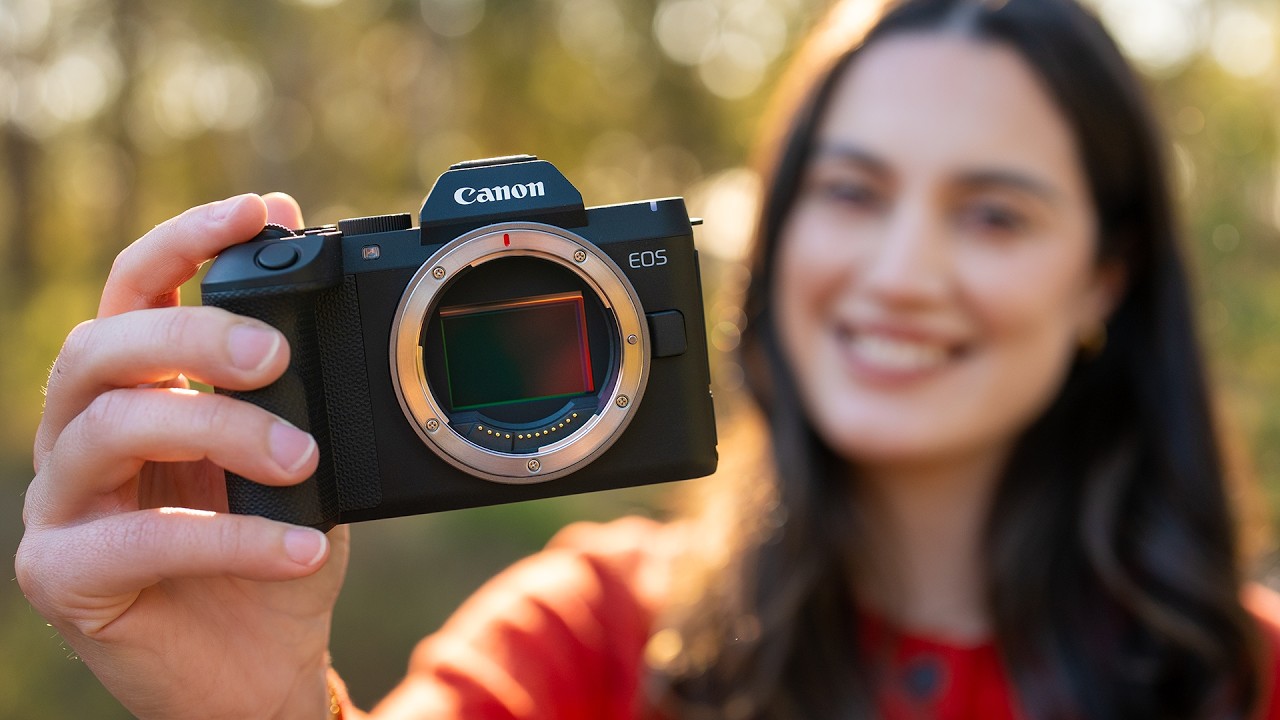
Best lenses for beginners on each camera
When someone asks me which camera to buy, I always say to look at the lenses first. Which lenses will you buy first, which will you want later, and do they exist for that brand at a price you like? Here are the small, affordable first-party lenses for each camera. Sony, Lumix and Nikon also have plenty of third-party options.
| Lumix S9 (L-Mount) | Sony A7C II (E-mount) | Nikon Z5II C (Z mount) | Canon R8 II (RF) | |
|---|---|---|---|---|
| Kit zoom | 18-40mm f/4.5-6.3 | 28-60mm f/4-5.6 | 24-50mm f/4-6.3 | 24-50mm f/4.5-6.3 |
| Wide prime (vlogging) | 20mm f/2.5 | 24mm f/2.8 G | 28mm f/2.8 | 28mm f/2.8 |
| Portrait prime | 40mm f/2 | 40mm f/2.5 G, 50mm f/2.5 G | 40mm f/2 | 45mm f/1.2 |
The Lumix kit lens is the widest and the Sony kit lens is the longest. For portraits, the Canon 45mm f/1.2 has the brightest aperture of these small primes. I compare which focal lengths work best for vlogging and everyday shooting in the video.
I've reviewed several of these lenses on my channel:
- Lumix 40mm f2 review
- Lumix 20mm f2.5 review
- Lumix S9 with 18-40mm vs Sony A7C II
- Sony G 24mm f2.8, 40mm f2.5 and 50mm f2.5 review
- Canon 45mm f1.2 review for portrait photography
So which is the best beginner camera for portraits?
All four are excellent first full frame cameras, and the right one depends on what matters most to you: size, resolution, a viewfinder, the shutter, video features, price or the lenses you want to use. Watch the full comparison video at the top of this post to see all four side by side for photo, video, low light and lenses, then decide which one suits you.
If you're picking up your first full frame camera, my YouTube channel has lots of tutorials to help you learn how to use it and take better portraits.
Beginner camera FAQ
What is the best beginner full frame camera for portraits?
The Lumix S9, Sony A7C II, Nikon Z5II C and Canon R8 II are four of the best small full frame cameras for beginners. Each is the smallest full frame camera from its brand, and all four take beautiful portraits. The best choice depends on whether you want a viewfinder, more megapixels, a mechanical shutter, video features or a lower price.
Which is the cheapest of the four?
At the time of writing, the Lumix S9 is the cheapest in the US, followed by the Nikon Z5II C, Canon R8 II and Sony A7C II. In Australia the Lumix S9 is also cheaper than the Nikon Z5II C.
Which of these cameras has a viewfinder?
The Sony A7C II and Canon R8 II have an electronic viewfinder. The Lumix S9 and Nikon Z5II C don't, so you compose on the rear screen.
Which is the lightest full frame camera?
The Lumix S9 is the lightest at 486g, followed by the Sony A7C II at 514g, the Canon R8 II at 546g and the Nikon Z5II C at 620g.
Which camera has the most megapixels?
The Sony A7C II has a 33MP sensor. The Lumix S9, Nikon Z5II C and Canon R8 II are around 24MP.
Which is best for video?
The Lumix S9 has the strongest video features, including 6K open gate. The Canon R8 II is the only one with full frame 4K 60p, and the Nikon Z5II C can record N-RAW.
What is the difference between the Nikon Z5II and Z5II C?
The Z5II C uses the same sensor and most of the same features as the Z5II, but it has no viewfinder and a single card slot, so image and video quality are the same.
Do all four have in-body image stabilisation?
Yes. All four have in-body image stabilisation, which helps with handheld photos and video.
All the portraits in this post were edited with my Lightroom presets: Amalfi, Mountains, Disposable Film, Lotus and Dulce. You can browse every pack in my Lightroom Presets for Portraits collection, and if you're stuck between a few, you can buy any 3 presets and save 10%.


0 comments